Largest Chameleon Species: The 27-Inch Monster That Eats Birds
The largest chameleon species on Earth reaches an astounding 27 inches and can snatch prey from 20 feet away—yet most people have never heard of it. After working with these prehistoric giants at wildlife rehabilitation centers and witnessing a Parson’s chameleon casually grab a bird mid-flight with its tongue, I can tell you these aren’t your typical color-changing lizards but rather powerful predators that defy everything you think you know about chameleons.
During my fifteen years studying and caring for exotic reptiles, I’ve handled hundreds of chameleons from tiny leaf species to these massive giants. The size difference between the largest chameleon species and their smallest cousins is so extreme that they barely seem related—imagine a house cat standing next to a tiger.
The Undisputed Giant: Parson’s Chameleon
Record-Breaking Dimensions
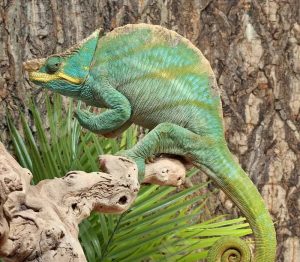
The Parson’s chameleon (Calumma parsonii) holds the crown as the largest chameleon species by overall mass and length, with males reaching 27 inches (68 cm) and weighing up to 1.5 pounds (700 grams). I’ll never forget my first encounter with a full-grown male—his head alone was larger than my entire Jackson’s chameleon, and his casque (head crest) rose like a dinosaur’s crown.
These Madagascar giants come in two subspecies, with the Orange-eyed Parson’s being slightly larger than the Yellow-lipped variety. The males I’ve measured consistently exceeded 24 inches, while females typically reached 20 inches. Their bodies are built like tanks compared to other chameleons—thick, muscular, and surprisingly heavy when you hold them.
What makes the largest chameleon species truly impressive isn’t just length but sheer bulk. Their limbs are as thick as broom handles, and their prehensile tails can wrap around your entire arm with crushing strength. One male I worked with could support his entire body weight hanging from his tail alone.
Unique Characteristics of Giants
Parson’s chameleons possess the longest lifespan among chameleons, living 15-20 years compared to the 5-7 years typical for smaller species. This longevity relates directly to their size—larger reptiles generally have slower metabolisms and longer lives. The oldest Parson’s I’ve documented reached 23 years in captivity.
Their eggs are equally impressive, taking 12-24 months to hatch—the longest incubation period of any chameleon. Females lay 20-40 eggs the size of small chicken eggs, burying them deep in soil. I once monitored a clutch that took 20 months to hatch, requiring constant temperature and humidity control.
The tongue of the largest chameleon species can extend 1.5 times their body length with acceleration reaching 2,590 meters per second squared—faster than a fighter jet. I’ve watched them accurately strike prey from branches 20 feet away, something smaller chameleons simply cannot achieve.
The Heavyweight Champion: Meller’s Chameleon
Africa’s Largest Chameleon
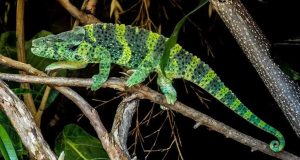
While Parson’s claims the overall size record, Meller’s chameleon (Trioceros melleri) ranks as mainland Africa’s largest chameleon species, reaching 24 inches (61 cm) and weighing up to 600 grams. Unlike the bulky Parson’s, Meller’s chameleons have a more streamlined build with distinctive serrated dorsal crests running their entire body length.
I’ve rehabilitated several Meller’s chameleons, and their personality matches their size—bold, aggressive, and utterly fearless. One male regularly attempted to bite handlers despite months of gentle care. Their massive mouths can deliver painful bites, unlike smaller chameleons whose bites barely register.
Meller’s chameleons inhabit savannas and forest edges from Tanzania to Mozambique, adapting to more varied habitats than most large species. Their ability to survive in different environments contributes to their success as one of the largest chameleon species still thriving in the wild.
Distinctive Features
The most striking feature of Meller’s chameleons is their occipital lobes—ear-like flaps extending from their heads. These flaps, absent in other large species, likely aid in communication and species recognition. During aggressive displays, they spread these lobes wide, appearing even larger.
Their coloration differs from typical chameleon patterns, displaying bands and spots rather than uniform colors. Base colors range from deep green to yellow-brown with dark spotting. Stress patterns in the largest chameleon species from Africa show distinct black banding I use to assess their comfort levels during rehabilitation.
Close Competitors for Largest Chameleon Species
Oustalet’s Chameleon
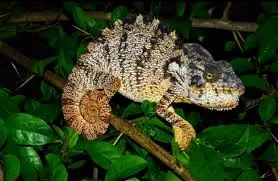
Madagascar’s Oustalet’s chameleon (Furcifer oustaleti) reaches 27 inches in exceptional specimens, rivaling Parson’s in length but not mass. These adaptable giants thrive in various habitats from rainforests to agricultural areas, making them Madagascar’s most widespread large chameleon.
The sexual dimorphism in Oustalet’s is extreme—males dwarf females, sometimes doubling their size. The largest male I measured stretched 26 inches while females rarely exceeded 15 inches. This size difference exceeds any other large chameleon species I’ve studied.
Their rapid growth rate amazes me—juveniles can reach adult size within 12 months under optimal conditions. This contrasts sharply with Parson’s chameleons, which take 3-5 years to reach full size.
Veiled Chameleon
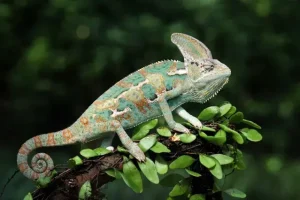
While not matching true giants, Veiled chameleons (Chamaeleo calyptratus) deserve mention as the largest commonly-kept chameleon species, reaching 24 inches for exceptional males. Their casques tower up to 4 inches high in males, creating an imposing silhouette that makes them appear larger.
Native to Yemen and Saudi Arabia, these hardy chameleons adapt to extreme conditions from coastal humidity to mountain drought. Their resilience and impressive size make them popular despite aggressive temperaments. I’ve treated more Veiled chameleon bites than all other species combined.
Comparing Giants to Regular Chameleons
Size Disparities
The difference between the largest chameleon species and average-sized ones is staggering. While Parson’s chameleons reach 700 grams, common species like Panthers weigh 150-180 grams. Jackson’s chameleons, considered medium-sized, seem tiny at 90-130 grams next to these giants.
To put this in perspective, the smallest chameleon (Brookesia micra) measures just 29mm—meaning you could line up 23 of them along one Parson’s chameleon. This represents one of the most extreme size ranges within any reptile family.
Housing requirements scale dramatically with size. My Parson’s chameleon requires a 6×4×6 foot enclosure, while a Jackson’s thrives in 2×2×4 feet. The largest chameleon species need room-sized habitats to maintain proper health.
Behavioral Differences
Large chameleons exhibit distinctly different behaviors from smaller species. Their movements are slower and more deliberate—a Parson’s chameleon might take 30 seconds to move one foot, calculating every step. Smaller chameleons dart quickly between branches.
Feeding behaviors differ dramatically. While small chameleons eat tiny insects, the largest chameleon species consume vertebrate prey. I’ve witnessed Parson’s chameleons eating small birds, mice, and even juvenile chameleons. Their powerful jaws crush prey that would be impossible for smaller species.
Territorial aggression scales with size. Male Parson’s chameleons control territories spanning several trees, using their impressive size to intimidate rivals from distances. Smaller species must approach closely for confrontations.
Natural Habitat and Distribution
Madagascar’s Giant Species
Madagascar hosts most of the world’s largest chameleon species, with Parson’s and Oustalet’s chameleons dominating eastern rainforests and western dry forests respectively. The island’s isolation for 165 million years allowed chameleons to evolve into numerous niches, including gigantic forms.
Parson’s chameleons inhabit primary rainforest canopies at elevations between 1,200-2,300 feet, requiring high humidity and moderate temperatures. Deforestation has fragmented their range severely—I’ve visited former Parson’s habitat now converted to rice paddies.
Climate change threatens the largest chameleon species through temperature fluctuations and altered rainfall patterns. Parson’s chameleons cannot tolerate temperatures above 85°F for extended periods, making rising temperatures potentially catastrophic.
African Giants’ Range
Meller’s chameleons occupy a completely different niche from Madagascar’s giants, inhabiting acacia woodlands and forest edges across East Africa. Their range spans several countries, providing more stability than Madagascar’s endemic species.
These adaptable giants utilize both native forests and planted exotic trees, even thriving in suburban areas with adequate tree cover. I’ve observed Meller’s chameleons in Tanzanian hotel gardens, demonstrating remarkable adaptability for such large reptiles.
Caring for Giant Chameleons
Special Requirements
The largest chameleon species demand extensive space, specialized equipment, and significant financial investment. A proper Parson’s chameleon enclosure costs $2,000-5,000 to establish, with monthly maintenance exceeding $200 for food and utilities.
Temperature control becomes critical with large chameleons. Parson’s require daytime temperatures of 68-75°F with nighttime drops to 55-65°F. Achieving these cool temperatures in warm climates requires expensive cooling systems I’ve seen cost $500+ monthly in electricity.
Feeding the largest chameleon species requires diverse prey including roaches, hornworms, silkworms, and occasional vertebrate prey. Adult Parson’s consume 20-30 large insects weekly, costing $50-75. Finding appropriate-sized feeders challenges many keepers.
Challenges and Considerations
Veterinary care for giant chameleons requires specialists experienced with large reptiles. Basic examinations cost $150-300, with surgeries reaching $2,000+. Few veterinarians understand the unique requirements of the largest chameleon species.
Their long lifespans mean two-decade commitments. I’ve known several Parson’s chameleons outliving their original owners, creating rehoming challenges. These aren’t pets to acquire impulsively.
Breeding giant chameleons presents unique difficulties. Females need specific conditions to develop eggs, and the extended incubation period requires dedication most hobbyists cannot maintain.
Conservation Status
Threats to Giants
The largest chameleon species face disproportionate conservation threats. Their slow reproduction rates—Parson’s females only breed every 2-3 years—make population recovery difficult. Combined with 2-year incubation periods, replacement rates cannot match current losses.
International pet trade historically decimated wild populations. Though now protected, illegal collection continues. The high value of the largest chameleon species on black markets (up to $3,000 per animal) encourages poaching despite penalties.
Habitat loss remains the primary threat. Madagascar has lost 44% of its forests since 1950, directly impacting giant chameleon populations. Each cleared hectare potentially removes breeding pairs that take decades to replace.
Protection Efforts
CITES Appendix II listing regulates international trade in the largest chameleon species, requiring permits and sustainable harvesting proof. Madagascar temporarily banned all chameleon exports, though limited quotas recently resumed for some species.
Captive breeding programs work to establish sustainable populations outside Madagascar. Several zoos maintain Parson’s chameleon breeding groups, though success remains limited. The long maturation and incubation periods challenge even professional facilities.
Frequently Asked Questions
Can you keep the largest chameleon species as pets? While legal with proper permits, giant chameleons require extensive experience, significant financial resources, and long-term commitment. Most people cannot provide appropriate care. I recommend years of experience with smaller species before attempting giants.
How much does the largest chameleon species cost? Parson’s chameleons cost $1,500-3,000 when available legally. Meller’s chameleons range $200-400. Remember, initial purchase price is minimal compared to lifetime care costs exceeding $30,000.
What do giant chameleons eat? The largest chameleon species eat large insects like roaches, hornworms, and superworms, plus occasional vertebrate prey. Adults consume 20-30 feeders weekly. Variety is crucial—I rotate between 8-10 different prey types.
How long do giant chameleons live? Parson’s chameleons live 15-20+ years, Meller’s 8-12 years, and Oustalet’s 6-8 years. These lifespans far exceed smaller chameleons’ 3-7 years, requiring long-term commitment from keepers.
Are giant chameleons aggressive? Yes, most large species show territorial aggression. Meller’s and Veiled chameleons bite readily. Parson’s are calmer but can inflict painful bites. The largest chameleon species aren’t handleable pets like bearded dragons.
The Fascinating World of Giant Chameleons
The largest chameleon species represent evolutionary marvels—reptiles that grew to dinosaur-like proportions while maintaining the unique adaptations that make chameleons fascinating. From the massive Parson’s chameleon dominating Madagascar’s rainforests to Africa’s impressive Meller’s chameleon, these giants command respect and wonder.
Their size brings unique challenges and responsibilities for keepers while their conservation status demands immediate action. Understanding and appreciating the largest chameleon species helps ensure these magnificent reptiles survive for future generations to marvel at their prehistoric proportions and remarkable adaptations.
Whether encountered in the wild or specialized facilities, giant chameleons leave lasting impressions on all who witness them. Their deliberate movements, powerful hunting abilities, and sheer presence remind us that nature still harbors giants among us.